Tag: badmintho

  • Your badminton matches, saved in your own Apple Health

    Your badminton matches, saved in your own Apple Health

    badmintho keeps no match database of its own. Every match you play is saved as a badminton workout in your Apple Health, and badmintho reads it back from there when you open History. This is what that workout holds, and why we built it that way rather than keeping a copy of our own.

    What one match holds

    • The workout. A badminton workout from the first serve to the end of the match, with each game inside it. When your Apple Watch records the match, the workout also carries the heart rate, energy and distance it measured.
    • Every point. Each point is saved as a marker at the moment it was scored, with the side that scored it and their new score.
    • The players. The names on each side, and which side was yours when you have picked your colour.
    • Umpire marks. If someone marked the rallies from a second phone, each winner, unforced error or service fault is saved beside the score of the rally it describes.
    • The court. If you switch on court tagging, the name and location of the court you played at.

    badmintho writes two kinds of data to Health: workouts, and water if you log a drink from the watch during a match. Everything else it asks for, it only reads.

    Why every point carries its moment

    Saving the final score would have been enough to show who won. We saved every point with its time instead, because the score of a match is a sequence, and the sequence is where the useful questions are: when did the game turn, and how long were the rallies?

    That decision paid off in badmintho 26.4. Its match details show each side’s longest scoring run, such as six points in a row from 8–11, and the typical rally length. Both are worked out from the markers a match already carries, so they appear for matches you played before 26.4 existed, not just for the ones after it. The match details come with badmintho Pro; the markers are saved with every match either way.

    Without a watch, nothing is made up

    If you keep score on the iPhone alone, the phone saves the match as a workout too: its time, the players and every point. What it does not save is heart rate, energy or distance, because the phone did not measure them. We could have estimated them. We chose an honest record of what happened over a figure that looks complete and is invented.

    With a watch, one match is one workout

    When the Apple Watch is recording the match, the phone steps aside. Two workouts covering the same time would count the match twice in your Activity rings, and Health does not merge them. So the phone saves only the part the watch did not cover, or nothing at all when the watch had the whole match, and the two parts add up correctly.

    Where the court is, not where you were

    Court tagging is off until you switch it on. When it is on, badmintho checks your position as you set up a match, only to suggest the nearest court you have saved. What goes into Health is that court’s name and its coordinates: the venue’s location, never your own. You can change or clear the suggestion before the match starts.

    Your matches stay yours

    Because the record lives in Health, it sits with the rest of your health data, under the permissions you set there. It does not depend on badmintho to exist:

    • Delete a match in Health and it is gone from badmintho’s History too, without restarting the app.
    • Stop using badmintho and the workouts stay in Health, with their time, heart rate and energy.
    • Withdraw access at any time in Settings › Health › Data Access & Devices.

    On the device, badmintho keeps your settings, your saved players and courts, and a cache of match details so History opens quickly. red8.io runs no server that receives your matches, and there is no account to create.

    What badmintho asks Health for

    The permission sheet lists only what the app actually uses on that device. On the iPhone it asks to read workouts, heart rate, resting heart rate, heart-rate variability and one-minute heart-rate recovery, active and resting energy, walking and running distance, steps and physical effort. The watch asks for the figures it records during a match, plus your water total for today and your date of birth, which sets the heart-rate zones. The badmintho privacy policy describes the rest, including the two things that can leave the app, and only if you switch them on.

    More

  • Before we translate a word

    Before we translate a word

    In slotho, “fast” means going without food. In badmintho, a “let” is a rally that gets played again. In pluris, the “vault” is where your passwords are kept, encrypted. Outside those apps, each of those words means something else, and a translator that does not know which app it is working in will reach for the everyday meaning. So every red8.io app keeps a short translation glossary of its own words, and none of an app’s text is translated without it.

    A label arrives without its screen

    Our apps are translated string by string, and a language model drafts each translation. The model is fluent in every language we ship. What it does not get is the screen: a button label such as “Share match” reaches it as two words, with no badminton court anywhere in sight.

    We saw what that costs in August. Told only that badmintho was a health-tracking app, the model read the badminton court as a court of law in 18 languages (Unbekanntes Gericht, German for “unknown court of law”) and a match as a coincidence in 8 (Partager la correspondance, French for sharing a correspondence). No automatic check caught either. Every string was present, every placeholder intact, every sentence grammatical. They were about the wrong thing.

    What goes in a translation glossary

    Each glossary is a page of plain writing, not a database. It says what the app is, who uses it and in what tone, then lists the words that could belong to more than one world: the meaning we want, and the meanings we do not.

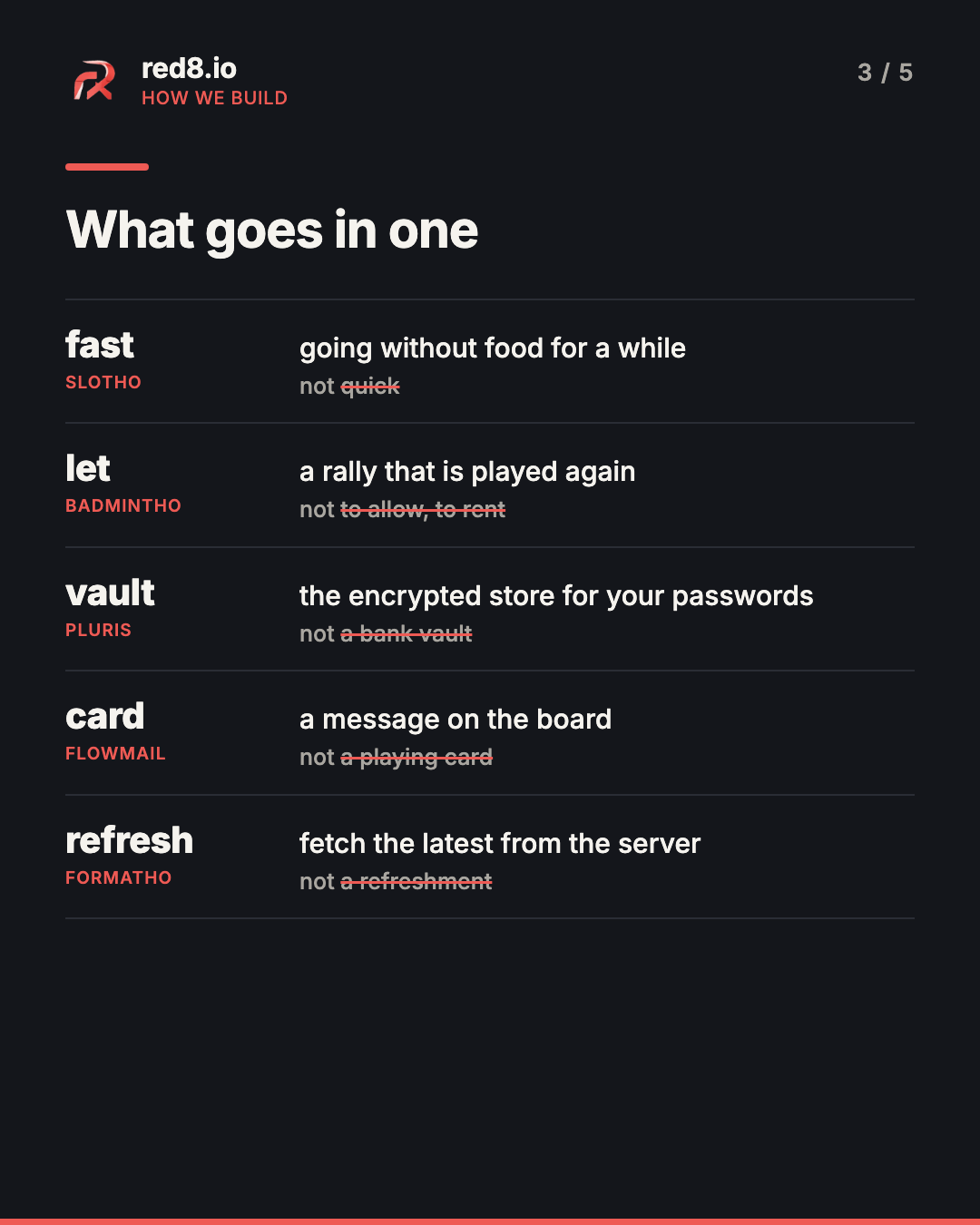
    WordAppWhat it means thereNot
    fastslothogoing without food for a whilequick
    stageslothoa phase of a fast, such as ketosisa theatre stage
    letbadminthoa rally that is played againto allow, to rent
    courtbadminthowhere badminton is playeda court of law
    vaultpluristhe encrypted store for your passwordsa bank vault
    blockplurisstop a number from calling youa city block
    cardFlowMaila message on the boarda playing card, a payment card
    refreshformathofetch the latest from the servera refreshment
    A translation glossary in five rows, one word from each red8.io app: fast in slotho means going without food, not quick; let in badmintho is a rally that is played again, not to allow or to rent; vault in pluris is the encrypted store for your passwords, not a bank vault; card in FlowMail is a message on the board, not a playing card; refresh in formatho means fetch the latest from the server, not a refreshment.
    One word from each app’s translation glossary.

    Below the word list sit the decisions that only make sense one language at a time. In Lithuanian and Latvian, slotho’s fasting is never the religious fast. iOS is not available in Estonian or Latvian, so an Estonian or Latvian slotho user’s Health app is almost always labelled in English; slotho calls it “Health” there too, rather than inventing a name the user will never see on their phone.

    Three rules around it

    • No glossary, no translation. The tool that translates our apps stops before it starts if the app has no glossary. That includes the translation step inside a release, which runs unattended, because an unattended run is exactly the one whose mistakes nobody reads before they ship.
    • It lives with the code. Each glossary sits in the app’s codebase beside the text it governs, changes in the same commit as the correction that taught us something, and is reviewed like code. All five apps got theirs in the same week of August 2026, and each has grown since.
    • One word per meaning, held by a test. A badminton match is made of games, and many languages have a sports word for one game that differs from their everyday word. German says Satz, not Spiel; Portuguese says set, not jogo. badmintho’s glossary names that word for twenty languages, and a test fails if any game string in those languages uses a different one.

    What you get from it

    slotho, badmintho and pluris are each available in 22 languages on the App Store, from Danish to Thai. Use one of them in German, Japanese or Polish, and the words on the screen were translated knowing whether they belong on a badminton court, in a fasting window or in a password vault. FlowMail and formatho ship in fewer languages today and keep a glossary as well, so each language they add starts from the same page.

    If a word reads wrong in your language, tell us. Each app’s FAQ says how to reach us (slotho, badmintho, pluris), and we correct the glossary along with the screen.

  • What holds your work together? Mine started as one iOS Shortcut

    What holds your work together? Mine started as one iOS Shortcut

    In July 2021 I published a post called Never again forget anything. It was about one iOS Shortcut. I ran it, typed or pasted a thought, and it put the thought where I would find it again: the clipboard into Data Jar, a task into Jira, a line into a work note. One entry point for every idea, so that nothing depended on my memory.

    I still work that way. What changed is what sits behind the entry point. The one Shortcut has turned into five things I built, and each of them took over one part of my day.

    What each one took over

    • slotho holds what I eat and how I feel afterwards. I log food and digestion symptoms, and it tells me which foods turn up before a symptom more often than on the days I did not eat them, from my own log.
    • badmintho holds my time off. It keeps the score on my Apple Watch while I play badminton, runs my drills, and saves every match and session to Apple Health.
    • FlowMail holds my email. It shows the inbox as a Kanban board, so a message has a status I can see, on Mac, iPhone and iPad.
    • pluris holds the things I cannot afford to lose. Passwords, passkeys and API keys go in its vault, and it keeps my contacts tidy.

    None of these was planned as part of a system. Each one started the way the Shortcut did: there was something I kept having to remember, and I wanted a place to put it the moment it happened.

    Where Cortex comes in

    Four apps that each remember one thing still leave a question: where does the work around them live? The release plan, the task that came out of a meeting, the document someone sent, the post announcing a new version.

    That is what Cortex is becoming for me. It is a hosted workspace, in the EU, where the tools share one memory. Today it holds:

    • My products. Every app is a product in Cortex, and it checks the App Store for the version that is actually live.
    • My projects and tasks. Each app is a project, and the issues from its code repository arrive as cards on the board.
    • My documents and meetings. Notes link to the task or the meeting they came from, and show its current state when I read them again.
    • What I publish. The LinkedIn post for a release is drafted and scheduled in the same place as the release itself.

    What is real today, and what is next

    Today Cortex runs the business side. What I put into the apps stays in the apps: a meal is in slotho, a match is in badmintho, a password is in pluris. Cortex knows about the products, and it holds the work of building them.

    Bringing the two closer is where I am taking it, and I will write about that when there is something to show. For now it already does the thing the Shortcut was for: I put something in once, and I find it again where I expect it.

    Your turn

    Everyone has one part of their day that still lives only in their head. Mine was ideas, in 2021. Tell me which part is yours.

    More